A3.2.2 Construct ERDs.
• The significance of entity relationship diagrams (ERDs) in crafting organized, efficient database designs tailored for specific applications
• The relationships between different data entities within a database
• The roles of cardinality and modality in defining relationships in ERDs
Big Idea
Entity–Relationship Diagrams (ERDs) are abstract visual models that map out the structure of a database by depicting entities (tables), their attributes, and the ways they interconnect. By formalizing how data components relate, ERDs guide developers to craft efficient, well-organized schemas that accurately reflect an application’s requirements before any physical implementation takes place.
1. Significance of ERDs in Database Design
ERDs serve as a blueprint for application-specific databases, enabling designers to:
- Clarify Requirements: Translate user needs and business rules into a precise model of entities and relationships, reducing misinterpretation.
- Optimize Structure: Reveal opportunities for normalization, ensure that each piece of data maps to exactly one place, and prevent anomalies.
- Facilitate Communication: Provide a common visual language for stakeholders (analysts, developers, DBAs) to discuss and validate the design long before tables are created.
2. Modeling Relationships Between Entities
In an ERD, a relationship links two or more entity types to express how instances of those entities interact:
- One-to-One (1:1): Each instance of Entity A corresponds to at most one instance of Entity B (e.g., each Employee has one PersonnelRecord).
- One-to-Many (1:N): A single instance of Entity A may relate to multiple instances of Entity B (e.g., one Customer places many Orders).
- Many-to-Many (M:N): Instances of Entity A can relate to multiple instances of Entity B and vice versa; implemented via a junction (associative) entity (e.g., Students enrolled in multiple Courses, and each Course has multiple Students).
3. Cardinality and Modality in ERDs
- Cardinality defines the numerical bounds of a relationship—how many occurrences of one entity may be associated with a single occurrence of another. It is expressed as minimum and maximum values (e.g., 0..* means zero or more; 1..1 means exactly one).
- Modality (also called participation constraint) specifies whether participation in a relationship is mandatory or optional:
- Mandatory (minimum = 1): Every instance of the entity must participate in at least one relationship (e.g., every Order must be placed by a Customer).
- Optional (minimum = 0): An entity instance may exist without being linked (e.g., a Customer may have zero Orders).
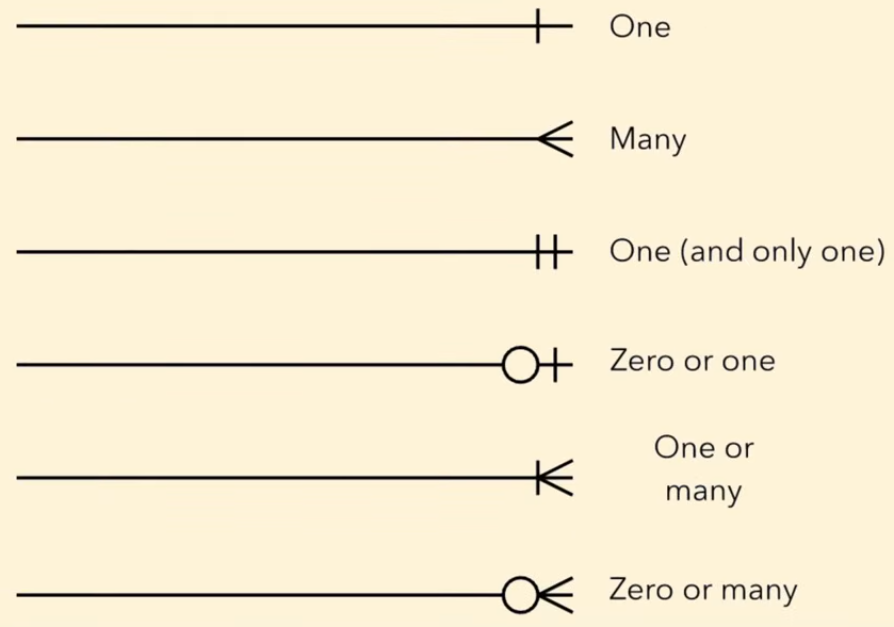
Together, precise specification of cardinality and modality ensures that the database enforces real-world rules at the schema level, preventing invalid or unintended data linkages.